
Every time we start a renovation in Altea, there’s one question almost every client asks too late: “do I need a permit for this?” And they usually ask it once the project is half-decided, the builders have a slot in their schedule, and nobody wants to wait six weeks for the town hall to reply.
The good news is that in Altea, most interior renovations (kitchens, bathrooms, flooring, painting) don’t need a formal license — just a simple “declaración responsable” (responsible declaration), which you file on the same day you start the work. The bad news is that because nobody explains the difference properly, people either over-process (losing weeks) or under-process (risking a fine that can reach €6,000).
Here’s the guide we give our clients before signing any quote: what paperwork Altea Town Hall actually asks for, how much it costs, how long it takes, and what changes if your home is in the old town or if you live outside Spain.
| Aspect | What you need to know |
|---|---|
| Interior renovation (kitchen, bathroom, flooring, painting, electrics) | “Declaración responsable” / express license — filed and works can start almost immediately |
| Removing a load-bearing wall, extending a terrace, touching the façade or roof | Major works license, requires an approved technical project |
| Basic documents for a responsible declaration | Application form, descriptive budget, proof of municipal fee payment |
| Documents for major works | Technical project, health & safety study, site supervision |
| Approximate cost | Municipal fee + ICIO construction tax + technical fees if applicable |
| Typical timeframe | Days for a responsible declaration; weeks or months for major works |
| Altea old town | Extra restrictions on façade, colour and materials |
| No license or declaration filed | Fines from €300 to €6,000, plus a stop-work order |
What type of permit you need, depending on the renovation
The question isn’t “do I need a license or not?” but “which procedure matches what I’m actually going to touch?” In Altea, as in the rest of the Valencian Community, the system has three levels, and most domestic renovations fall into the first or second.
Level 1 — No paperwork at all. Painting the interior, changing furniture, replacing interior doors, swapping a tap or a light point without touching the general installation. This can be done without notifying the town hall.
Level 2 — Responsible declaration (the “express license”). This covers the vast majority of the renovations we do: updating a kitchen or bathroom without moving load-bearing walls, changing floors, redistributing space with plasterboard partitions, updating plumbing or electrics, installing indoor air conditioning units. You file an application with a descriptive report of the work and proof of fee payment, and you can start the works almost immediately. The town hall reserves the right to inspect afterwards, but you don’t have to wait for prior approval.
Level 3 — Major works license. If the project affects structural elements (beams, columns, load-bearing walls), the façade, the roof, or involves increasing the built surface (enclosing a terrace, adding a floor), then you need a major works license. This requires a technical project signed and approved by an architect or building surveyor, a basic health & safety study, and the appointment of site supervision.
The most common trap we see is in kitchen renovations that “seem simple” but involve knocking through the wall between the kitchen and living room to create an open-plan space. If that wall is load-bearing — very common in Altea buildings from the 1970s-80s — it stops being a responsible declaration and becomes major works, with everything that implies for timelines and the cost of the technical project. That’s why, before promising dates to a client, we always ask to see the building’s original plans or, if they don’t exist, we open up a section of the wall to confirm whether it’s load-bearing.
What paperwork Altea Town Hall asks for (and what people usually forget)
This is where most generic guides fall short, because they list “what the law requires” in general terms, not what the Urban Planning desk in Altea actually checks.
For a responsible declaration (interior renovations):
- General application form, downloadable from Altea Town Hall’s Electronic Office (Sede Electrónica).
- A descriptive report or budget of the work: what’s being done, in which rooms, with which materials. A generic “full home renovation” won’t do — the more detail you provide, the less likely they’ll request additional information afterwards.
- Proof of self-assessed payment of the corresponding municipal fee.
- If the building has a homeowners’ association and the work affects communal elements (for example, replacing an exterior window or installing a visible outdoor air conditioning unit), you’ll need the association’s agreement or sign-off. This is, by far, the document that delays applications the most: many communities in Altea only meet once a year.
For major works:
- A basic and execution technical project, approved by the relevant professional body (Colegio de Arquitectos de la Comunidad Valenciana or Colegio de Aparejadores).
- A basic health & safety study.
- Appointment of site supervision (the technician who will oversee the works).
- A notarial deed confirming the start of works, in some cases.
- A simple note (“nota simple”) from the Land Registry and a copy of the title deed: the town hall needs to verify that the applicant has a legal relationship with the property.
- Proof of IBI (property tax) payment: although not always mandatory, in practice it speeds up processing considerably because it confirms the property’s cadastral identification.
A detail almost nobody mentions: if the descriptive report you submit doesn’t exactly match what’s eventually carried out — for example, you say you’re changing the flooring but also move a non-structural partition you didn’t declare — technically you’re carrying out a different work than the one declared. Surprise inspections are rare, but if a neighbour files a complaint (which happens more often than you’d think in communities with foreign owners who only visit in summer), the file gets checked against what was declared.
How much it actually costs: municipal fee, ICIO tax and technical fees
When a client asks “how much will the paperwork cost me?”, they’re actually asking about three separate items that add up — and almost no guide separates them clearly.
1. The municipal processing fee. This is what Altea Town Hall charges to review and approve the file, whether it’s a responsible declaration or a license. It varies depending on the type of procedure and, in some cases, on the surface area affected. For a responsible declaration for a standard kitchen or bathroom renovation, it’s usually a fixed, moderate amount; for major works, the calculation is more complex because it factors in surface area and the execution budget.
2. ICIO (Construction, Installations and Works Tax). This is the one that surprises people most, because it’s not a fee for “processing the paperwork” — it’s a tax on the value of the work itself. The town hall applies a percentage to the material execution budget (or to a reference value calculated using its own valuation module if it considers the declared budget too low). That’s why two identical renovations can pay different ICIO amounts if one declares a realistic budget and the other underdeclares it to “save money”: the town hall has valuation modules per square metre precisely to correct for this.
3. Technical fees. These only apply if you need a project (major works) or, in some complex responsible-declaration cases, a technical certificate confirming the work doesn’t affect the structure. This cost isn’t charged by the town hall but by the architect or building surveyor, and it’s worth requesting as a fixed quote from the start, since it can vary a lot between professionals.
| Item | Who charges it? | What does it depend on? |
|---|---|---|
| Processing fee | Altea Town Hall | Type of procedure (responsible declaration or major works) |
| ICIO tax | Altea Town Hall | Material execution budget or valuation module |
| Technical fees | Architect / building surveyor | Only if a project or technical certificate is needed |
| Accessory fees | Altea Town Hall | Use of public space for skips, scaffolding or fencing |
A practical tip we always give: if you’re requesting quotes from several renovation companies, ask each one to break down the cost of the works separately from the cost of the license/ICIO/fees. It’s common for some companies to “bundle” the fee into the overall quote without explaining it, which makes comparing quotes almost impossible.
How long it takes and how to track it without visiting the town hall
In practice, the responsible declaration doesn’t have a formal “waiting period”: you submit the documentation and, unless something’s missing, you can start the works practically the next day. That doesn’t mean the file is closed — the town hall retains the right to review it afterwards, usually within a period of several months, so it’s worth keeping copies of everything submitted (including proof of payment) for at least a couple of years.
A major works license is a different story. Here there is a formal procedure with an explicit decision, and it involves municipal technicians reviewing the project, checking it complies with current urban planning regulations and, occasionally, requesting additional documentation (which in practice adds weeks to the process). In small municipalities like Altea, timeframes tend to be shorter than in large cities, but “shorter” still means several weeks, not days, and it can stretch out further if the file lands during periods of lower administrative activity (for example, around Easter or in August).
What has changed in recent years is that most of these procedures — submitting applications, paying fees, checking the status of a file — can be done through Altea Town Hall’s Electronic Office (Sede Electrónica), without needing to travel. This is especially relevant if you don’t live in Spain permanently, which is the case for many of our clients in Altea.
If your home is in Altea’s old town, extra rules apply
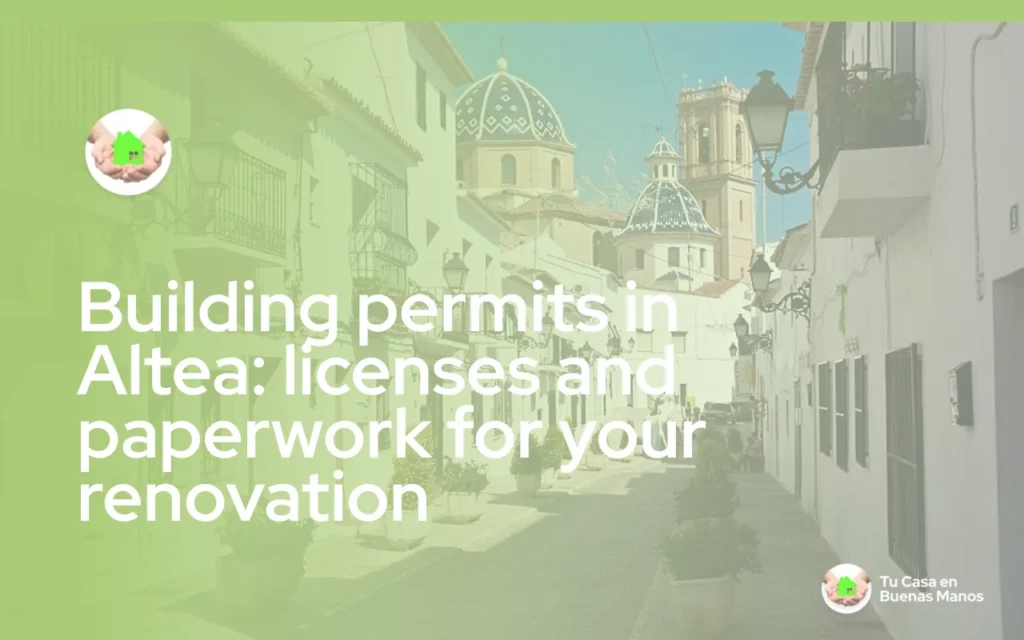
This is something practically no generic article about building licenses in Spain mentions, and in Altea it’s relevant because much of the appeal — and value — of homes in the old village, around the streets near the Virgen del Consuelo church with its blue domes, comes precisely from its uniform look: white façades, traditional joinery and details, characteristic volumes.
If your home is within that protected area, any work affecting the exterior — changing the colour or material of the façade, replacing windows or shutters visible from the street, modifying the roof, installing an outdoor air conditioning unit or an aerial — is subject to additional protection criteria for the historic ensemble, on top of the standard planning procedure. In practice, this means the town hall can require you to maintain specific materials, colours or proportions, even for works that would be a simple responsible declaration anywhere else in Altea.
We’ve seen this with clients who wanted to replace the original wooden shutters with aluminium ones: the interior renovation was processed without any issue as a responsible declaration, but replacing the exterior shutters required a specific prior consultation to confirm which finishes were acceptable. If your home is in this area, our advice is simple: before buying materials or requesting a quote for exterior joinery, ask first what’s allowed. It’s much cheaper to ask beforehand than to take it down afterwards.
Owners who don’t live in Spain: how to handle the license without being there
A significant share of the owners we work with in Altea — Belgian, Dutch, British, German — have their home as a second residence and only spend a few weeks a year here. For them, the question isn’t just “which license do I need” but “do I have to fly to Spain to sign it?”
The short answer is no, as long as it’s arranged in advance. The usual mechanism is granting a power of attorney (this can be done before a notary in your home country and then legalised, or directly before a Spanish notary during a visit) in favour of the company managing the renovation, an administrative agent, or the technician signing the project. With that power, the appointed person can file the responsible declaration or license application, pay the fees and receive notifications on the owner’s behalf.
Two things worth sorting out before leaving Spain if you’re a non-resident owner:
- An up-to-date NIE. This is the number that identifies the owner in any procedure with the Spanish administration, including paying ICIO and the municipal fee. If it’s expired or poorly linked to the property, it delays the application.
- An active Spanish bank account for fee and tax payments. Some town halls accept payments from foreign accounts, but the self-assessment process runs much more smoothly with a local account.
In our experience, the projects that get delayed most aren’t the ones with complex technical documentation, but the ones that depend on the owner “being around” in Altea to sign something specific. Sorting out the power of attorney on the first visit — even if the renovation will only happen months later — saves weeks of emails and international courier shipments afterwards.
What happens if you do the renovation without notifying the town hall
The temptation to “start now and legalise later if needed” exists, especially for renovations that seem minor. But it’s worth being clear about the real risk:
If the town hall detects works without the corresponding responsible declaration or license — whether through an inspection, a neighbour’s complaint, or because a certificate is later requested to sell the property — the usual consequences are a financial penalty (which, depending on severity, can range from a few hundred euros to several thousand) and, in more serious cases, a stop-work order until the situation is legalised.
Retrospective legalisation isn’t always possible under the same conditions as if it had been processed beforehand: if the work doesn’t comply with current regulations (for example, it has reduced minimum ventilation or natural light, or affects structural elements without proper technical backing), the town hall can require part of the work to be undone.
There’s also a less-discussed but very practical consequence: if you ever want to sell the property, the buyer (or their notary) can ask for the certificate for the last renovation or whether visible works — a redistribution, a new window, an enclosed terrace — are legalised. An unpermitted renovation can become a problem in the middle of a sale negotiation, years after it was done, exactly when it’s least convenient.
That’s why, even for the simplest renovations, our recommendation is straightforward: before the first worker arrives, have the responsible declaration filed and the payment receipt saved. It’s a procedure that takes a couple of days and avoids headaches that can take years to su
- Steps to Take for a Full Home Renovation in Altea - July 19, 2026
- Façade Renovation Grants in Altea: Up to €1,000 from the Town Hall - July 19, 2026
- Grants for Renovating Your Home in Altea: A Complete Guide - July 17, 2026